
A New Strategic Framework in the AI Era: Mapping Future Business Models of Law


Originally published on Law.com, this article is part of the exclusive insights and analysis available to subscribers. We are pleased to make it available here to a wider audience.
In the last three months, have you wondered how much legal work would be impacted by generative AI?
Have you thought about where to implement the technology and what skills are needed to do so? Have you thought even further out about what the choices you and the industry make now mean for your business model in five, 10 or 15 years? Which providers will be solving legal questions? What will the role of the lawyer of the future be?
Leading experts in innovation in the legal industry, operating at the forefront of disruption and change, are still left to wonder where it will all head and what is to come next. The smartest people in the room in this area quietly tell us they are struggling to define next steps, see around corners and lead a paradigm shift in the way legal services are bought, sold and delivered.
But what if we had the luxury and the tool set to think beyond the messiness of disruption and look to where the industry may find itself in the longer term?
A group of leading law firm leaders, general counsel, legal technologists, investors, academicians and industry experts have spent the last year working together to create the space and process map to make the future less scary and visible earlier. At the November TLTF Summit, we will share the results of this industry-wide research.
But before we get there, it's important to explain the methodology, who was in the room and how we see organizations using this framework to prepare for their own futures—or even chart them while there is still time.
Pathways: Future of the Business of Law 2040, started in November 2025 at the TLTF Summit, where more than 100 leaders across law captured the biggest changes happening in the industry and the biggest uncertainties that linger over what the future may hold. From there, Law.com, the TLTF Fund and Harvey partnered for phase 2 of the project to put those accepted truths and uncertainties through a rigorous examination under the Three Horizons framework designed by futurist Bill Sharpe, an adviser to this project along with his colleagues at the Leaders’ Quest.
The ultimate outcome was the creation of four plausible, challenging and relevant scenarios in which the industry might find itself in 2040. These are NOT predictions. They are realistic possibilities, based off of current events, that, when mapped out, give us sign posts we can watch for over the next 15 years. This not only makes the future less scary as it arrives, but it gives us agency over that change. We don't have to sit and wait passively and expect change to come. We can map how the future may play out and take agency of that direction in the intervening years.
Before explaining the Three Horizons framework and what the biggest uncertainties are, it's important to understand why we did this work in the first place. As Law.com chairman David Levin explains from his work using Three Horizons for strategic planning at prior companies, disruption happens when what was scarce becomes abundant, or vice versa.
Legal is standing in front of exactly that kind of inversion. The cost of computing power—drafting, reviewing, researching and analyzing: the work that has been scarce and expensive for as long as there has been a profession—is being recalculated. What was rationed by the hour is becoming abundant. And when the scarce becomes abundant, nothing downstream stays where it was.
Which brings us to the one reliable fact: the future is uncertain, and confidence about it is the least reliable guide of all. The useful response is not to predict harder. It is to hold several plausible futures in view at once, to notice the early signals of each, and to make decisions that hold up across more than one of them. The research to be released at the Summit is not a forecast, but rather several maps—and the guidance on how to absorb it before the terrain is fixed.
What is the Three Horizons Framework?

Three Horizons is a way of seeing the future in the present. Horizon One is the world as it runs today: the dominant, stable system, superbly optimized for a set of conditions that are quietly expiring. Horizon Three is the set of desirable futures visionaries already hold in their minds: the world that will gradually emerge as new patterns take hold. Horizon Three offers glimpses into pockets of the future. Horizon Two is the contested middle: the turbulent zone of experiment and innovation where the entrepreneur lives, where the ideas that will define Horizon Three fight it out with the defenders of Horizon One. Mapping a system across these three horizons lets a group of people see, together, which parts of the present are load-bearing and which are already cracking.
'We don't have to sit and wait passively and expect change to come. We can map how the future may play out and take agency of that direction in the intervening years.'
The 10 Truths
In phase 1 of Pathways, more than 100 industry leaders, from law firm managing partners to GCs and more, developed and pressure-tested a list of truths. These were trends actively happening in the market identified as having staying power.
1. Compute becomes abundant. The underlying technology paradigm keeps shifting as raw capability gets cheaper and more plentiful.
2. Capital keeps flowing in. Investment and entrepreneurial energy continue to pour into legal services.
3. C-suite pressure intensifies. Demand rises to cut cost and move toward outcome-based pricing rather than by the hour.
4. Legal activity grows exponentially. As cost falls and access widens, the sheer scale and speed of legal work expands.
5. Documents become dynamic. Static agreements give way to data-driven agreements and systems that update, monitor and act.
6. Human and machine workflows fuse. The two stop being separate steps and become one integrated process.
7. Capability gets systematized — and judgment gets more valuable. As routine work becomes scalable and self-service, differentiated human judgment becomes the scarce premium.
8. Trust shifts to evidence. Confidence rests increasingly on data and demonstrated performance rather than institutional reputation alone.
9. The talent pipeline is reshaped. Training, apprenticeship and entry pathways into the profession are rebuilt as the entry-level work changes.
10. Institutions strain to keep pace. Legal, regulatory and professional systems face growing pressure to move at the speed of the market.
Put together, the 10 point in one direction for every scenario we explored: faster, cheaper and more visible legal activity.
The Three Uncertainties
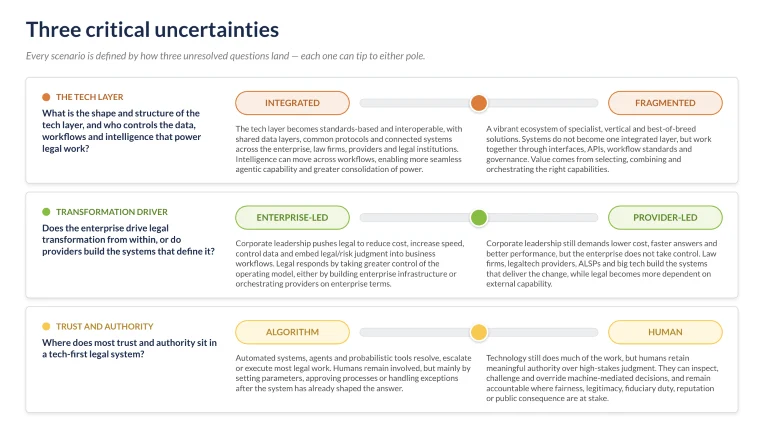
While some things may be certain, three looming uncertainties presented themselves above all others, with each, depending on which way they tilt, having a substantial influence on what the future of law looks like.
The tech layer. What is the shape of the technology that powers legal work, and who controls the data, workflows and intelligence inside it? It can become integrated—standards-based, interoperable, with shared data moving across connected systems within an organization—or stay fragmented, a vibrant ecosystem of specialist, best-of-breed tools that must be selected, combined and orchestrated.
The transformation driver. Does the enterprise drive its own legal transformation, or do outside providers build the systems that define it? Either the change is enterprise-led, with corporate legal taking control of the operating model, or it is provider-led, with law firms, legaltech, ALSPs, and big tech building the infrastructure and legal depending on it. Client buying behavior and corporate appetite for legal ownership will dictate much of this moving forward.
Trust and authority. In a tech-first legal system, where does trust ultimately sit? Will legal decisions be algorithm led, with automated systems that resolve, escalate, or execute most work, while humans set parameters and handle exceptions? Or will decisions continue to be mainly human led, where people retain authority over high-stakes judgment and can inspect, challenge and override the machine?
Running beneath all three uncertainties is a deeper question of trust itself—in people, platforms, data and institutions. It is not a fourth axis. It is the condition that every scenario builds, strains, or transfers in its own way.
From this work, a team of industry leaders spent the last six months developing detailed scenarios that could emerge in the future, depending on where the balance tips across each of the uncertainties. These scenarios had to be plausible, relevant and challenging. Four scenarios were developed, all with very different outcomes, but all with present-day evidence that they could plausibly exist. Each outcome means something very different depending on where you sit in the legal ecosystem. The work was done from the vantage point of the general counsel, but also explored through the lens of law firms, legal technology companies and ALSPs and the consumer and general public.
The four scenarios will be brought to life at the TLTF Summit in Scottsdale in November, in an immersive experience that will help attendees start to think about how they can take agency over their future.
"My advice to law firms, corporate legal departments, technology providers and investors is not to mistake adopting AI for transforming legal services," said Whitney Stefko, director and senior counsel of policy and legal ops at Ford Motor Company, and a Pathways participant. "The harder and more consequential work involves redesigning workflows, incentives, roles, governance and measures of value around what the technology now makes possible. Each stakeholder should be asking not only, ‘What can this tool do?’ but also, ‘What should the legal experience become—for the client, the professional, and the people ultimately affected by the work?’ The organizations that start experimenting thoughtfully now will be much better positioned than those waiting for certainty.”
Mapping to the future is in Law.com's DNA. This Pathways work enhances and complements the expanding Law.com ecosystem of critical quantitative data and market-leading qualitative analysis, which put benchmarking metrics into context and drive understanding of what changes over time may really mean.
'Disruption happens when what was scarce becomes abundant, or vice versa.'
To be a part of the conversation at the Summit, apply to attend here. To hear more about the research from the participants themselves, register for our Oct. 21 webinar on Law.com.
The Pathways work was convened by the TLTF Fund, Law.com and Harvey. Participants included:
Laurie Basch, McKinsey
Gina Passarella, Law.com
Richard Caruso, Law.com
Michael Pastor, New York Law School
Vince DiMascio, Skadden
Farrah Pepper, Harvey
Zach Posner, The LegalTech Fund
Timothy Fraser, Toshiba
Ken Priore, DocuSign
Steve Harber, Cimplifi
Anu Sethee, LegalZoom
Yath Ithyakumar, Morgan & Morgan
Michael Shea, McDermott
Carly Levin, The LegalTech Fund
Sumeet Singh, Lighthouse AI
David Levin, Law.com
Mark Smolik, DHL
Bridget McCormack, American Arbitration Association, now of Clio
Whitney Stefko, Ford
Visit Law.com to explore ongoing insights from the Pathways: Future of Law 2040 findings and access the signals, scenarios, and strategic intelligence helping legal industry leaders prepare for what's next.
Not a subscriber? Complete the form below to learn about subscription options and gain access to the analysis, trends, and insights shaping the future of the legal profession.
See How Law.com Can Support Your Next Decision
You’ve seen the insights. Now see how they apply to your business. Connect with our team to explore how Law.com helps legal leaders anticipate risk, benchmark performance, and act with confidence.
Legal Market Intelligence for Leaders Navigating Change
Our analysis, case studies, opinions, and reports are designed to help you interpret what’s happening across the business of law and translate it into action. Whether you are assessing market moves, evaluating strategic options, or building internal alignment, each piece is grounded in real signals from the legal industry.


See What Law.com Can Do for Your Team
Get a closer look at how Law.com delivers decision-ready intelligence for legal leaders. Request a demo to see how data, analysis, and market context can support your law firm’s next move.