
Why Legal Teams Can’t Wait: The Supreme Court Is Reshaping the Rules in Real Time
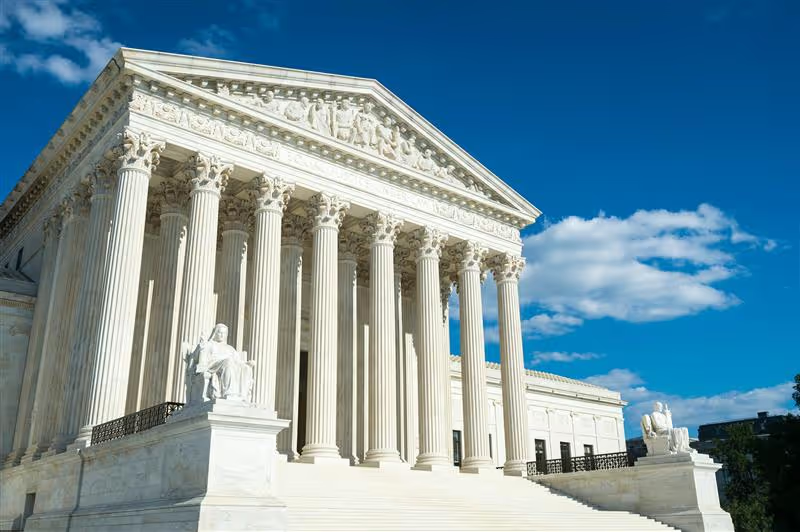

The U.S. Supreme Court is shaping the legal operating environment at a pace that is hard for institutions to absorb. The volume of consequential questions, combined with the speed of interim orders, means legal risk can shift between quarterly planning cycles.
Across the merits docket and the shadow docket, the Court is assessing foundational constitutional questions alongside emergency applications and procedural disputes. The implications can be immediate for government power, business regulation, elections, labor and employment, and civil rights. For law firms and in-house teams, that mix increases the likelihood that a single ruling can trigger multi-jurisdiction ripple effects.
The pressure is not only substantive. Scrutiny of Court process, transparency, and ethics continues to rise. That creates reputational and communications considerations for clients whose matters intersect with politically salient disputes, and it raises internal governance questions about how to explain uncertainty to boards, stakeholders, and regulators.
To make sense of the term, it helps to focus on three impact vectors: the Court’s accelerated decision mechanics, the practical signals embedded in arguments and orders, and the operational layer that sits around opinions, including technology and transparency.
A Court in Constant Motion
In recent terms, the Court’s workload has expanded beyond its merits docket. Emergency rulings on compressed timelines can set nationwide rules before full briefing or argument. Doctrinal shifts can cascade across multiple practice areas at once. Closely watched cases, such as election administration and administrative power disputes, often turn on signals surfaced in oral argument and procedural posture as much as in final opinions.
Disputes touching birthright citizenship and election administration illustrate how much the Court can shape strategic choices before a final ruling. Questions from the bench and procedural decisions can indicate how the Court is interpreting the 14th Amendment, the limits of executive authority, and the practical reach of federalism and separation-of-powers constraints. For practitioners, those signals inform posture, including what to preserve, where to narrow claims, and how to calibrate arguments for durability on appeal.
For leadership teams, the practical question is how to respond under uncertainty. When emergency orders arrive quickly and opinions land late in the term, legal strategy needs a clear framework for triage, communications, and scenario planning across jurisdictions.
What to Watch Beyond the Merits Docket
The shadow docket is no longer a niche concern. Emergency applications can change the rules while litigation is still underway, affecting enforcement, compliance decisions, and venue strategy. For regulated industries, that can mean adjusting policy under compressed timelines and limited explanatory guidance, while still anticipating how a later merits decision could affirm, narrow, or reverse the interim outcome.
This environment also changes how legal work gets staffed and sold. Clients are asking for faster interpretation of Supreme Court signals, clearer explanations of downstream risk, and practical playbooks that connect doctrine to operational decisions. For law firms, that increases pressure to provide coordinated, cross-practice guidance rather than isolated updates from a single specialty.
Another underappreciated variable is the advocacy ecosystem. A concentrated group of elite advocates and clinics appears frequently at the lectern, and their repeat exposure can influence how arguments are framed and how doctrine develops. For organizations considering Supreme Court litigation, that reality affects budgeting, talent strategy, and the decision of when to elevate an issue to the Court versus pursuing alternative routes.
Finally, legitimacy and transparency debates are becoming part of the operating context for legal strategy. Questions about ethics, disclosure, and public access can shape stakeholder reactions even when an opinion is doctrinally narrow. That makes communications planning and internal alignment an increasingly important companion to the legal work itself.
Taken together, these dynamics reinforce a simple point: Supreme Court impact is not confined to June opinions. It shows up earlier, through signals, procedure, and operational constraints that legal teams have to manage in real time.
Beyond the Opinions: Technology, Transparency, and the Business of Law
The Court’s influence isn’t limited to doctrine. Access and transparency questions, from cameras in the courtroom to the operational realities of emergency orders, are becoming strategic variables for communications, stakeholder management, and risk planning. In parallel, legal teams are testing how artificial intelligence can strengthen Supreme Court litigation preparation, signaling a shift in how high-stakes advocacy is staffed and executed.
Supreme Court Brief has evaluated how AI-generated video and new formats are changing public access to proceedings, and examined how practicing lawyers are applying AI tools to oral-argument preparation. Together, these developments indicate that even the Court’s most tradition-bound workflows are intersecting with modern legal technology. They also suggest that competitive advantage increasingly includes process, not just doctrine.
Individually these shifts can look incremental. Collectively, they signal a Court operating in a more visible, fast-moving environment where legal, business, and technology considerations increasingly overlap.
How Legal Teams Can Respond
In this term’s environment, many teams are strengthening three habits: tracking Supreme Court signals earlier than the opinion release, mapping plausible outcomes into scenarios, and pre-aligning internal stakeholders on what would change under each scenario. That approach shortens response time when an order or opinion lands.
It also helps to separate immediate legal effect from longer-term doctrinal direction. A narrow procedural ruling can still signal broader limits on agency authority, standing, or remedies. Building an institutional view across multiple cases can improve litigation positioning and client counseling, particularly for organizations with recurring exposure to federal regulation or election-related disputes.
Underpinning these habits is a research-led approach to interpretation. The strongest teams pair doctrinal analysis with context about practice impact, client risk, and the business implications of uncertainty. That combination is what turns Court activity into a usable decision framework.
Supreme Court Brief: A Decision-Ready Companion to the Term
For teams that need a consistent view of what the Court is signaling across a full term, Law.com’s Supreme Court Brief provides a regular podcast and expert briefing that assesses arguments, opinions, emergency orders, and procedural moves in practice context. The focus is on implications and strategic options, including how Court signals may influence litigation posture, regulatory exposure, and client advisory work.
Recent briefings have examined constitutional challenges, election-law disputes with multistate consequences, and evolving areas such as gun-rights jurisprudence. They also evaluate system-level dynamics, including who argues cases and how repeat-player advocates can shape precedent.
A Core Part of Law.com’s Supreme Court Intelligence
Supreme Court Brief sits within Law.com’s broader Supreme Court intelligence offering, alongside expert analysis and practice-context interpretation across key areas. Together, these resources provide continuity across terms and help leaders translate Court activity into action.
As the Court continues to issue consequential rulings, and to shape outcomes through interim orders, having a reliable guide to implications, scenarios, and strategic options has never been more important.
Explore Law.com’s Supreme Court intelligence hub for ongoing analysis and decision-ready insight now. United States Supreme Court Topic | Law.com or Listen to Supreme Court Brief on the Law.com Podcast Center law.com/podcastcenter/
See How Law.com Can Support Your Next Decision
You’ve seen the insights. Now see how they apply to your business. Connect with our team to explore how Law.com helps legal leaders anticipate risk, benchmark performance, and act with confidence.
Legal Market Intelligence for Leaders Navigating Change
Our analysis, case studies, opinions, and reports are designed to help you interpret what’s happening across the business of law and translate it into action. Whether you are assessing market moves, evaluating strategic options, or building internal alignment, each piece is grounded in real signals from the legal industry.


See What Law.com Can Do for Your Team
Get a closer look at how Law.com delivers decision-ready intelligence for legal leaders. Request a demo to see how data, analysis, and market context can support your law firm’s next move.